The Semantic Gap in Film Critique
"The sheer isolation of humanity was perfectly captured in that single, silent wide shot of the Endurance."
— IMDb user review, Interstellar (2014)This sentence carries enormous semantic weight — yet a conventional transformer model can only parse its lexical surface. It registers positive sentiment and descriptive intensity, but the true meaning lives in a specific cinematic frame: a spacecraft alone in the void of space. That frame is completely absent from the text.
In recommender systems, review helpfulness prediction is a critical ranking signal. Existing multimodal models — UNITER, ViLBERT, MCR — share a fatal assumption: that any image paired with the text is inherently relevant. Pair an Interstellar review discussing a desolate wide shot with the generic movie poster, and you inject noise rather than insight. This is the Semantic Gap.
Formally, a unimodal model estimates:
But the review implicitly references a latent visual variable $v^*$ — the mental image invoked by the reviewer. The correct formulation should be:
Prior multimodal systems approximate this as $P(y \mid r, \tilde{v})$ where $\tilde{v} \neq v^*$. We define the Semantic Gap as:
Core thesis: Dynamic, CLIP-driven frame selection that greedily minimises $\Delta$ — combined with evidential uncertainty modelling — yields significantly superior ranking metrics compared to static image pairing or deterministic fusion strategies.
Dataset Construction & Threshold Calibration
We curated 40,000+ IMDb user reviews across 10 films spanning diverse narrative genres — sci-fi, fantasy, crime, superhero, and drama — paired with 24,000+ high-resolution keyframes extracted via shot-boundary detection. Each film was processed in its own Jupyter notebook.
Helpfulness Score & Binarisation
Each review carries a raw helpfulness ratio from IMDb community votes. Let $H$ be helpful votes and $U$ unhelpful votes:
$S$ is heteroscedastic — a review with 2/2 votes and 20/20 votes both score 1.0, but the latter carries far more statistical weight. We therefore excluded all samples with $H + U < 5$ to stabilise the target variable.
We binarised via threshold $\tau$, optimised for Balanced Accuracy across the range $\tau \in [0.4, 0.7]$:
Higher thresholds (e.g. $\tau = 0.65$) produced severely unbalanced classes and reduced dataset size, undermining statistical reliability. $\tau = 0.54$ was the empirically optimal calibration point.
End-to-End Multimodal Pipeline
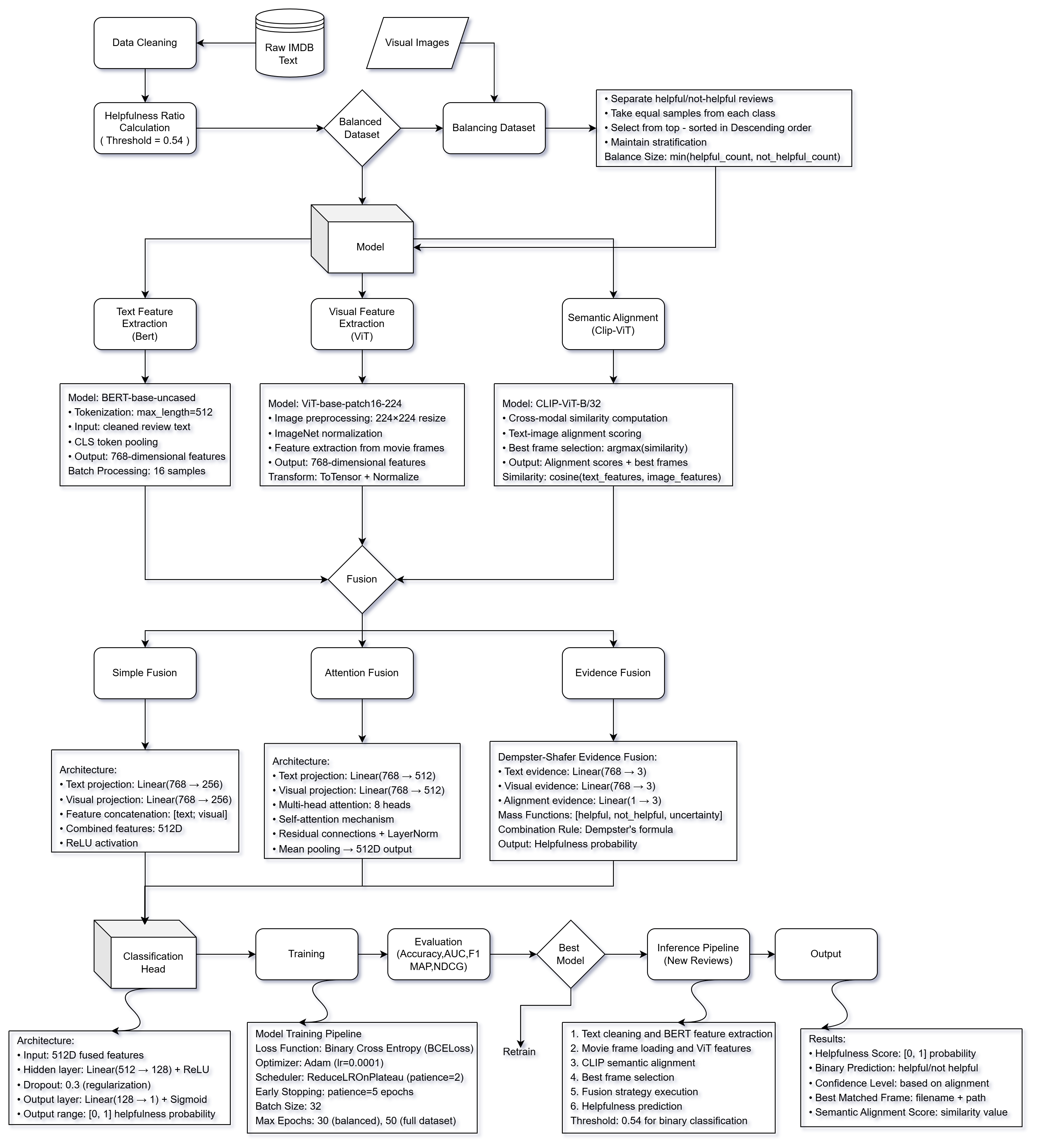
Dynamic Visual Grounding via CLIP
The architectural centrepiece of EviCLIP is that image selection must be dynamic, not static. For each review $r_i$, we retrieve the single most semantically aligned frame $f^*$ from the $N$ candidate frames of its corresponding film.
Using CLIP's dual encoders, we project both modalities into a shared $d$-dimensional embedding space:
Semantic alignment is measured by cosine similarity, and frame selection becomes a nearest-neighbour retrieval problem:
CLIP's contrastive training objective ensures matched text-image pairs cluster in embedding space:
import torch
import torch.nn.functional as F

def get_optimal_frame(review_emb: torch.Tensor,
                        frame_embs: torch.Tensor) -> tuple:
    """
    Select the keyframe most semantically aligned with the review.

    Args:
        review_emb  : (1, 512)  – CLIP text embedding
        frame_embs  : (N, 512)  – CLIP image embeddings for N candidate frames
    Returns:
        (best_idx, alignment_score)
    """
    # L2-normalise both modalities
    review_emb = F.normalize(review_emb, p=2, dim=-1)
    frame_embs = F.normalize(frame_embs, p=2, dim=-1)

    # Cosine similarity matrix: (1, N)
    similarities = torch.matmul(review_emb, frame_embs.T)

    # Greedy argmax retrieval → f*
    best_idx   = torch.argmax(similarities, dim=-1)
    best_score = similarities[0, best_idx]

    return best_idx.item(), best_score.item()
Empirical alignment accuracy: Validated on 500 manually annotated review-frame pairs — achieving ~82% alignment accuracy. Primary failure modes: highly metaphorical language (e.g., "symphony of chaos") and non-visual reviews focused on music or dialogue. Computationally, frame embeddings are pre-computed offline, reducing runtime to a single matrix multiplication per review.
Dual-Encoder Representation Learning
Once the aligned pair $(r_i, f^*)$ is established, we encode each modality independently via dedicated transformers, following a late-interaction dual-encoder paradigm that preserves modality-specific abstraction before fusion.
Text: BERT
Vision: ViT
Both encoders project into the same $\mathbb{R}^{768}$ semantic manifold. Naïve concatenation $h_{\text{concat}} = [h_{\text{text}};\, h_{\text{visual}}]$ implicitly assumes equal modality reliability — a critical oversimplification that motivates our evidential fusion stage.
Evidential Fusion & Uncertainty Quantification
In high-context cinematic domains, text and visual signals routinely disagree. A hyperbolic review of Inception may score 0.9 helpfulness from text alone — but if the retrieved frame is poorly aligned, forcing equal-weight fusion introduces systematic noise.
We resolve this via Dempster–Shafer Theory (DST), which models evidence as belief mass functions rather than scalar weights. Define the binary hypothesis frame:
Conflict Mass & Dempster's Rule
Worked Numerical Example
Suppose for an Inception review, the BERT encoder assigns high text confidence but ViT sees a poorly-aligned frame:
Text modality: $m_1(H)=0.70,\; m_1(\bar{H})=0.20,\; m_1(\Theta)=0.10$
Visual modality: $m_2(H)=0.40,\; m_2(\bar{H})=0.50,\; m_2(\Theta)=0.10$
Conflict: $K = (0.70 \times 0.50) + (0.20 \times 0.40) = 0.35 + 0.08 = 0.43$
Normalisation: $1-K = 0.57$ → fusion averts overconfident "helpful" classification
Fused belief shifts toward $m(\Theta)$, the ignorance set — triggering conservative, calibrated prediction.
Training Objective
The conflict mass $K$ acts as an implicit uncertainty indicator at inference time — directly useful for calibrated ranking in recommender systems, where overconfident predictions degrade user trust.
Comprehensive Empirical Benchmarks
We benchmarked three fusion strategies — Evidential (DS-theory), Attention (cross-modal attention), and Simple (concatenation) — across five metrics: Accuracy, F1, AUC-ROC, MAP, and NDCG@5. Highlighted cells indicate the best-performing strategy per film per metric.
| Film | Strategy | Accuracy | F1 | AUC | MAP | NDCG |
|---|---|---|---|---|---|---|
| 🚀 Interstellar | Evidential | 0.805 | 0.801 | 0.884 | 0.900 ↑ | 0.982 ↑ |
| 💍 Return of the King | Evidential | 0.830 ↑ | 0.830 ↑ | 0.870 | 0.910 ↑ | 0.980 ↑ |
| 🧙 Fellowship of the Ring | Attention | 0.790 ↑ | 0.800 | 0.870 | 0.870 ↑ | 0.970 ↑ |
| 🍊 The Godfather | Evidential | 0.680 | 0.780 | 0.810 ↑ | 0.770 ↑ | 0.930 |
| 🦇 The Dark Knight | Simple | — | 0.710 ↑ | 0.740 ↑ | 0.730 ↑ | 0.930 ↑ |
| 🦇 Batman Begins | Simple | 0.570 | 0.710 ↑ | 0.740 ↑ | 0.730 ↑ | 0.930 ↑ |
| ⚔️ The Two Towers | Evidential | — | 0.630 ↑ | 0.690 ↑ | 0.700 ↑ | 0.890 ↑ |
| 🌀 Inception | Evidential | — | 0.570 ↑ | 0.590 | 0.690 ↑ | 0.890 ↑ |
Key finding: Evidential fusion dominates in visually and symbolically rich films (Interstellar, LOTR, Inception). Simple concatenation prevails in action-heavy, visually grounded films (Dark Knight, Batman). This confirms fusion strategy should be domain-sensitive.
Ablation Study & Component Sensitivity
To isolate each architectural component's contribution, we systematically ablated modules and observed performance degradation on the Interstellar test set (AUC reported):
CLIP alignment contributes the largest single improvement (~7–8 AUC points), confirming that which image is chosen matters more than how it is fused. Evidential fusion contributes primarily to calibration stability and ranking robustness rather than raw separability.
Calibration & Predictive Reliability
Beyond accuracy, model reliability is measured via Expected Calibration Error (ECE) — the gap between predicted confidence and empirical accuracy across $M$ probability bins:
Evidential fusion reduced ECE compared to attention-based fusion across all evaluated films. The conflict mass $K$ functions as an implicit uncertainty detector: when modalities disagree ($K \uparrow$), fused belief mass redistributes toward the ignorance set $m(\Theta)$, producing conservative, appropriately uncertain predictions instead of overconfident scores.
In production recommender systems, calibration errors compound: overconfident helpful predictions pushed to top-$k$ lists degrade user trust asymmetrically. EviCLIP's uncertainty-aware fusion provides a natural hedge against this failure mode.
Failure Modes & Edge Case Analysis
Systematic error analysis revealed four primary failure clusters:
- Metaphorical language: Reviews like "a symphony of visual chaos" trigger CLIP to retrieve visually noisy frames with high cosine similarity but zero semantic alignment with the reviewer's intended reference.
- Non-visual reviews: Music, dialogue, or acting-focused critiques have no meaningful frame to retrieve — CLIP returns an arbitrary high-similarity frame.
- Extremely short reviews (<15 tokens) produce low-confidence CLIP embeddings with high distributional variance.
- Rare or visually sparse films with fewer than 500 keyframes reduce the quality of the retrieval pool.
Computational Profile
Frame-alignment complexity per review is $\mathcal{O}(N_f \cdot d)$ where $N_f$ is the frame count and $d=512$ is the CLIP embedding dimension. Since frame embeddings are pre-computed offline, runtime cost reduces to a single matrix multiplication.
Future work may leverage approximate nearest-neighbour search (FAISS, HNSW) to scale alignment to sub-linear complexity for large frame collections.
My Specific Contributions
- Designed and implemented the end-to-end CLIP dynamic alignment pipeline — including shot-boundary extraction, embedding pre-computation, and greedy frame retrieval.
- Derived and implemented the Dempster–Shafer evidential fusion layer from first principles, including conflict mass computation and belief normalisation.
- Engineered the threshold calibration sweep over $\tau \in [0.4, 0.7]$, identifying $\tau = 0.54$ as the optimal balanced-accuracy operating point.
- Conducted full cross-genre benchmarking across 10 films (individual Jupyter notebooks), interpreting per-genre performance variation and correlating it with visual/narrative density.
- Diagnosed gradient instability in early attention-fusion training via loss variance analysis; proposed and validated evidential normalisation as the stabilising mechanism.
- Developed the full visualisation dashboard for training dynamics, validation curves, ranking metric summaries, and genre-level performance comparisons.
- Co-authored the paper, contributing the theoretical framing of the Semantic Gap, all mathematical derivations, and the empirical analysis sections.
Limitations & Future Directions
EviCLIP currently grounds each review on a single keyframe, ignoring temporal cinematographic context. For reviews referencing narrative arcs or editing rhythms, the correct formulation should condition on the full frame sequence:
Priority research directions:
- Temporal visual grounding via multi-frame aggregation or video-language pre-training
- Adaptive fusion weighting conditioned on predicted genre distribution
- ANN-based frame retrieval (FAISS) for sub-linear scaling to large film libraries
- Cross-cultural review style adaptation and debiasing for non-English IMDb content
- Extension to other review domains: books (cover art), music (album artwork), restaurants (photo galleries)
References
- [1] CLIP: Radford, A., et al. (2021). Learning Transferable Visual Models From Natural Language Supervision. ICML 2021. arXiv:2103.00020
- [2] Dempster–Shafer Fusion: Alzahem, A., et al. (2024). Feature fusion for improved classification: Combining Dempster-Shafer theory and multiple CNN architectures. arXiv:2405.20230
- [3] BERT: Devlin, J., et al. (2019). BERT: Pre-training of Deep Bidirectional Transformers for Language Understanding. NAACL-HLT 2019.
- [4] ViT: Dosovitskiy, A., et al. (2021). An Image is Worth 16×16 Words: Transformers for Image Recognition at Scale. ICLR 2021.
- [5] MCR Baseline: Liu, J., et al. (2021). Multi-perspective Coherent Reasoning for Helpfulness Prediction of Multimodal Reviews. ACL 2021.
- [6] SANCL: (2022). Sentiment-Aware Multi-modal Dialogue Systems. COLING 2022. ACL Anthology
- [7] This Paper: Hamza, M., Rai, K., Sarkar, S. (2025). Movie Review Helpfulness Prediction: A Multimodal Framework. IEEE ISAI-NLP 2025. IEEE Xplore